What players say
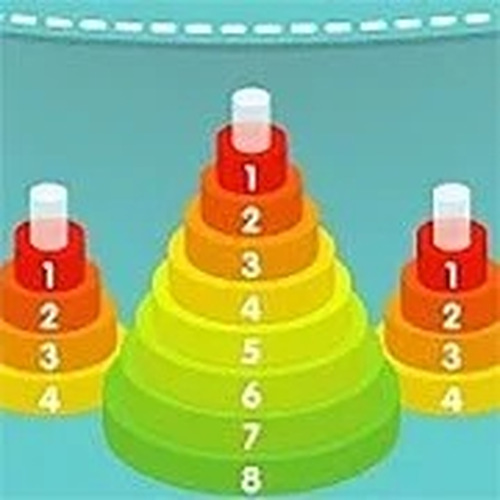
Tower of Hanoi Puzzle Game is a faithful adaptation of the classic logic puzzle. The interface is clean and easy to use, making it accessible for all ages. Starting with 3 disks helps beginners learn the pattern, while the option to increase to 4 disks adds replayability. The lack of time limits reduces stress and encourages thoughtful play. It is an excellent tool for improving problem-solving skills and patience. Perfect for quick mental breaks or longer training sessions.
About this game
Game Introduction
Tower of Hanoi is a classic logic puzzle that challenges your problem-solving skills. The objective is to move a stack of disks from one peg to another, following simple rules: only one disk can be moved at a time, and a larger disk cannot be placed on a smaller one. This game is suitable for all ages and offers a fun, educational experience that sharpens the mind. Start with a few disks to grasp the pattern, then progress to more disks for greater challenge. Enjoy engaging gameplay with no time limits or stress.
How to Play
To play Tower of Hanoi, you start with a stack of disks on the leftmost peg. Your task is to move all disks to the rightmost peg. You can click on a peg to select the top disk, then click on another peg to place it. Remember, you can only move one disk at a time, and you cannot place a larger disk on a smaller one. A helpful hint: begin with a small number of disks and observe the repeating pattern. Once you master that, try more disks using the same pattern. This step-by-step approach makes the game easy to learn but hard to master.
Game Features
This family-friendly puzzle game features simple rules and increasing difficulty. There are no time limits, so you can play at your own pace. The clean and intuitive interface is suitable for both children and adults. Playing helps develop logical thinking and patience. The game is free to play online with no downloads required.
Tips for Success
Start with a small number of disks to understand the basic pattern. Practice regularly to improve your speed and efficiency. Focus on moving the largest disk only when necessary. Try to visualize the sequence of moves before executing them. If you get stuck, take a break and come back with a fresh perspective. The key is patience and logical planning.